
Foraging Chanterelles and Dyers Polypore with Otis: Natural Dyes and Spring Collection Update

Some walks begin with a basket. Some begin with a dog who has already decided which trail you are taking.
That was the case on my recent foraging trip with Otis. He bounded ahead with his usual confidence, nose low, tail high, while I followed with a basket, a small knife, and the kind of hopeful patience that mushroom hunting always asks for. We were looking for chanterelles, but I was also keeping an eye out for one of my favorite dye mushrooms, dyer’s polypore.
Foraging is part treasure hunt, part slow study. The woods teach you to look closely. A splash of orange under leaves. A velvety bracket on the base of a conifer. The way rain changes everything. Otis, of course, thinks the best part is the mud.
Finding chanterelles without taking too much
One of the best lessons foraging teaches is restraint. I leave plenty in place. Mushrooms are only the fruiting bodies of a much larger organism living in the soil and around tree roots. Taking less helps keep the patch productive and gives wildlife something to enjoy too.
A few habits make foraging more respectful:
Harvest only what you can use
Fresh mushrooms do not wait politely in the refrigerator forever.
Leave small mushrooms to mature
Give them time to grow and release spores.
Avoid trampling the area
Step carefully around moss, seedlings, and the hidden network beneath your feet.
Check local rules
Parks, preserves, and public lands can have different foraging guidelines.
Keep dogs close
Otis loves a ramble, but I keep him where I can see him, especially around unfamiliar plants and fungi.
Chanterelles bring a special kind of excitement because they connect dinner to place. A small handful sautéed simply can carry the whole memory of the walk. But on this trip, the brightest find was not only for the kitchen. It was for the dye pot.
Why dyer’s polypore is a natural dye favorite
Dyer’s polypore is one of those fungi that looks like it belongs in the dye world from the start. Also known as Phaeolus schweinitzii, it often grows near the base of conifers or from buried roots. Young specimens can be soft and velvety with yellow-green edges and warm rusty brown centers. Older ones deepen into browns and can become tougher and more woody.
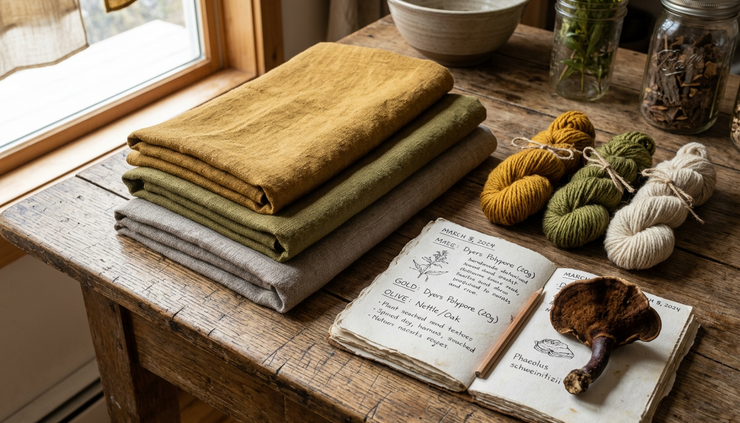
For natural dye work, dyer’s polypore is a generous teacher. It can produce a range of colors depending on the age of the mushroom, the fiber, the water, and the mordant used. On wool and other protein fibers, it is known for giving yellows, golds, warm tans, olive greens, and earthy browns. The results can feel both wild and wearable.
I love it because the colors have depth. They do not look flat. Even a simple dye pot can create shades that remind me of pine needles, dry grass, bark, and late afternoon sun.
Dyer’s polypore also fits beautifully into a thoughtful natural dye practice.
It is locally gatherable in many regions.
When harvested responsibly, it can reduce the need for packaged dyes shipped from far away.
It makes use of seasonal abundance.
Some dye mushrooms appear in generous flushes. Drying extras lets the color carry into another season.
It offers variation instead of sameness.
Natural color shifts with place, timing, and process. That is part of the beauty.
It works well for small-batch dyeing.
You can test a little at a time, build a sample library, and learn from each pot.
Mordants can shift the final color. Alum often supports clear yellows and golds, while iron can move the dye toward olive, gray-green, or deeper earthy tones. I keep careful notes because two pots that look similar at the start can become very different by the end.
Those notes matter. They help me repeat favorite colors, or at least get close. Natural dyeing always has a little mystery in it, but documentation turns the mystery into a conversation rather than a guessing game.

What dyer’s polypore brings to the early spring collection
The upcoming natural dye collection for early spring is taking shape around the colors I crave at that time of year. Early spring is not all flowers and bright greens. It is also thawing soil, wet bark, pale grass, lichen, seed heads, and the first soft hints of new growth.
Dyer’s polypore fits that mood perfectly.
The collection will lean into grounded, woodland-inspired shades. Think golden moss, muted straw, soft olive, bark brown, and warm lichen tones. These are colors that sit comfortably with linen, wool, denim, cream, and all the quiet staples that carry us from winter into spring.
I am especially excited about how dyer’s polypore pairs with other natural dye materials. Its yellows and greens can stand alone, but they also make a beautiful base for layering. A dyer can start with one color, then shift it with another plant or mineral modifier. That is where natural dye work feels almost like painting.
The early spring collection will include small-batch pieces, which means no two items will be exactly alike. Some variations will be subtle. Others may show the mark of the pot more clearly. I see those differences as part of the story. Each piece carries the season, the materials, and the handwork behind it.
I am planning with wearability in mind. Natural dyes can be soft and earthy, but they do not have to disappear. The goal is color that feels alive, calm, and easy to use. Pieces that look good on a gray morning. Pieces that still feel right when the first warm day finally arrives.
A few foraging notes before you head out
If this post has you reaching for a basket, I love that. A few simple reminders can keep the experience safe and respectful.
Never eat a wild mushroom unless you are completely confident in the identification. Use more than one trusted source, and learn from people with local experience whenever possible. Photos alone are not always enough.
Know the land rules before you collect. Some places allow personal foraging. Others do not. Private land needs permission, and protected areas should be treated with extra care.
Bring the right supplies. I like a basket or breathable bag, a small knife, a brush, water, snacks, and a notebook. If Otis is with me, I bring water for him too and check him for ticks afterward.
Most of all, harvest with gratitude. Take only what you can use. Leave the woods better than you found them. Pay attention to what grows nearby, what changes week to week, and what returns year after year.
Follow along for the spring dye collection
I will be sharing more as the early spring natural dye collection comes together, including color previews, process notes, and behind-the-scenes glimpses from the dye pot. If you love earthy color, foraged materials, and small-batch work rooted in the season, I would be happy to have you follow along.
Please visit my website for the latest updates, collection details, and more information as launch plans come together. That will be the best place to see what is available, learn about the materials, and catch new posts from the studio and the trail.
The best part of this work is how it keeps everything connected. A damp trail becomes a dye pot. A mushroom becomes color. A walk with Otis becomes part of a spring collection. And one quiet morning in the woods can keep unfolding long after we have shaken the leaves from our boots.


Comments